10 Tech Trends That Will Shape the Next Decade
10 Tech Trends That Will Shape the Next Decade
10 Tech Trends That Will Shape the Next Decade
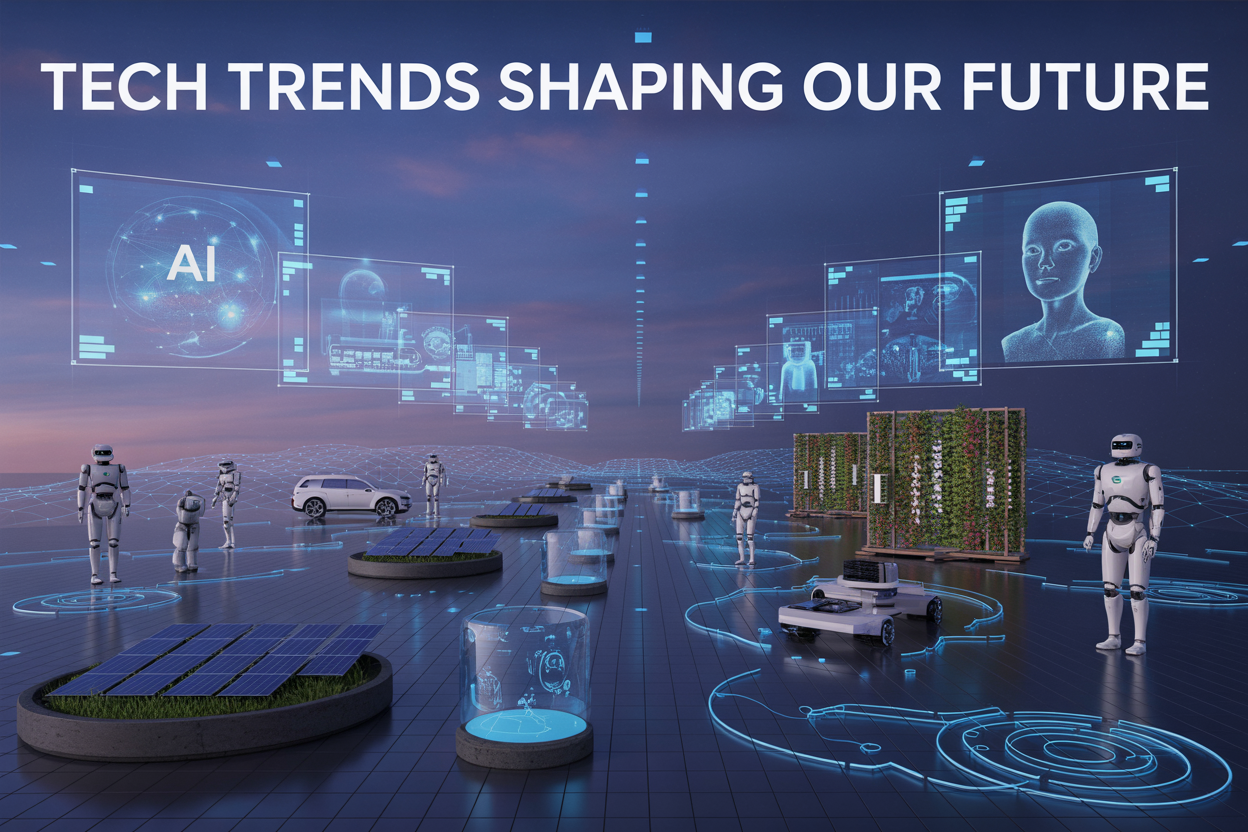
Looking for what's next in technology? The next ten years will bring massive changes across industries. This guide helps tech professionals, business leaders, and curious minds understand what's coming and how to prepare. We'll explore AI's continued expansion, quantum computing's practical applications, and how XR will transform more than just gaming and entertainment.
Artificial Intelligence Revolution

How AI will transform business operations
AI isn't just coming for business operations—it's already here, reshaping everything from customer service to supply chains. Companies adopting AI are seeing productivity boosts of 30-40% across departments.
The real game-changer? Predictive analytics. Businesses are using AI to forecast market trends with shocking accuracy, sometimes predicting shifts months before humans spot the patterns. Target famously knew a teenager was pregnant before her father did, based purely on her shopping patterns.
By 2030, AI will handle roughly 80% of routine business decisions, freeing humans to focus on creative and strategic work. The companies that thrive won't be the ones replacing workers—they'll be the ones augmenting their teams with AI assistance.
AI in healthcare: Personalized medicine breakthroughs
Healthcare is where AI truly becomes life-changing. We're moving beyond one-size-fits-all treatments toward medicine tailored to your unique genetic makeup.
AI systems are now analyzing patient data across millions of cases, identifying patterns no human doctor could spot. The results? Treatment plans are customized down to the molecular level.
Companies like Deep Genomics are utilizing AI to identify potential drug candidates in days rather than years. Their algorithms can predict how genetic mutations will affect gene expression and identify compounds to address these specific issues.
For patients, this means treatments with higher success rates and fewer side effects. Cancer treatment is leading this revolution—several major hospitals already use AI to analyze tumor samples and recommend personalized therapy options with success rates 30% higher than standard approaches.
Ethical considerations and regulatory challenges
The AI revolution raises tough questions for which nobody has perfect answers yet.
Who's responsible when an AI makes a harmful decision? The developer? The user? The AI itself? Current laws simply weren't written with autonomous systems in mind.
Privacy concerns are multiplying as AI systems require massive data sets to function effectively. Your data might help train systems that benefit millions, but do you have any say in how it's used?
Bias remains a stubborn problem. AI systems trained on historically biased data perpetuate and sometimes amplify those biases. An AI hiring tool at Amazon had to be scrapped after it systematically discriminated against women applicants.
Governments are scrambling to catch up. The EU's AI Act represents the first comprehensive attempt to regulate AI systems based on risk levels, while the US is taking a more sector-specific approach.
The future of human-AI collaboration
The most promising future isn't AI replacing humans—it's AI partnering with us.
This collaboration model is already proving more effective than either humans or AI working alone. Studies show human-AI teams in medical diagnosis achieve 22% fewer errors than either doctors or AI systems working independently.
New interfaces are making these partnerships more intuitive. Voice assistants are evolving into true collaborators that understand context and can maintain ongoing project awareness. Brain-computer interfaces, while still primitive, show early promise for direct mental control of AI systems.
The workplace of 2030 will feature AI handling routine tasks while amplifying human creativity and decision-making. Expect to see AI copilots embedded in nearly every professional tool, offering suggestions, automating tedious work, and providing real-time analysis.
The winners of the AI revolution won't be those who simply deploy the technology—they'll be those who design thoughtful human-AI workflows that leverage the strengths of both.
Quantum Computing's Coming of Age

Breaking computational barriers with quantum supremacy
Quantum computing isn't just coming—it's already here, breaking barriers we once thought insurmountable. In 2019, Google's 53-qubit Sycamore processor performed a calculation in 200 seconds that would take the world's most powerful supercomputer 10,000 years. That's not an incremental improvement. That's a complete paradigm shift.
But what does quantum supremacy mean for you and me? Simply put, problems that were practically impossible to solve are suddenly within reach. Drug discovery that once took decades might now happen in months. Climate models that were previously too complex to run may finally provide the insights we need.
The magic happens through qubits—quantum bits that can exist in multiple states simultaneously. While your laptop's bits are either 0 or 1, qubits exist in a unique quantum realm where they're both 0 and 1 simultaneously until measured.
Industries poised for quantum disruption
Financial services will likely feel Quantum's impact first. Portfolio optimization, risk analysis, and fraud detection are about to get a serious upgrade. Major banks aren't just watching—they're investing heavily.
Pharmaceutical companies stand to revolutionize drug discovery. Molecules that are too complex to model on classical computers can be perfectly simulated with quantum systems.
| Industry | Potential Quantum Applications |
|---|---|
| Finance | Trading algorithms, risk assessment, fraud detection |
| Pharma | Drug discovery, protein folding simulation |
| Logistics | Supply chain optimization, routing efficiency |
| Energy | Materials science, grid optimization |
Security implications in a post-quantum world
The encryption protecting your bank accounts, health records, and private messages? Quantum computers will crack it like an egg.
Current encryption relies on mathematical problems that would take classical computers billions of years to solve. Quantum computers could potentially do it in hours or minutes. That's why cryptographers are racing to develop quantum-resistant algorithms before powerful enough quantum computers arrive.
The NSA and major tech companies aren't waiting around. They're already transitioning to "post-quantum cryptography" standards that can withstand quantum attacks.
This isn't just a technical problem—it's a race against time. Organizations storing sensitive data need to become "crypto-agile" now, ready to swap in new encryption methods when needed.
Extended Reality (XR) Beyond Entertainment

Virtual workplaces and the future of remote collaboration
Extended Reality isn't just for gamers anymore. Companies are racing to build virtual workplaces that feel eerily real. Microsoft's Mesh and Meta's Horizon Workrooms are already letting remote teams collaborate in shared digital spaces.
Think about it - no more staring at 2D Zoom grids. Instead, you're sitting across from your colleague's avatar, sharing 3D models you can both grab and manipulate. The project planning session becomes interactive, with virtual whiteboards that you can actually walk around.
The tech isn't perfect yet. Headsets need to get lighter, and avatars less awkward. But major players are betting billions, this is where work is heading.
XR in education and training
The classroom is about to get wild. Medical students are already practicing surgeries in VR, making mistakes without consequences. History classes teleport kids to ancient Rome. Auto mechanics are learning to fix engines without touching a wrench.
What makes XR training stick? Research shows retention rates jump by up to 75% compared to traditional methods. When you physically "do" something in VR rather than just read about it, your brain processes it differently.
Schools and companies are noticing the cost benefits, too. Training 1,000 employees in a virtual environment costs a fraction of flying them to a central location.
The metaverse economy
A digital land grab is happening right now. Virtual real estate on platforms like Decentraland and The Sandbox has sold for millions. Brands from Nike to Gucci are rushing to establish metaverse storefronts where your avatar can shop for digital and physical goods.
The numbers are getting serious:
-
Virtual goods market: $50+ billion annually
-
Digital real estate sales: Over $500 million in 2022
-
Virtual events attracting millions of attendees
This isn't just about selling digital sneakers. It's creating entire new job categories: metaverse architects, virtual event planners, digital fashion designers, and avatar stylists. The creator economy is expanding into dimensions we couldn't imagine five years ago.
Healthcare applications transforming patient care
XR is revolutionizing healthcare in ways sci-fi writers predicted decades ago. Surgeons use AR overlays during complex procedures, seeing patient vitals and 3D anatomical maps without looking away from the operating field.
For patients, the changes are equally dramatic. VR therapy is showing remarkable results for:
-
Chronic pain management (reducing reliance on opioids)
-
PTSD and phobia treatment
-
Physical rehabilitation
-
Anxiety and depression
Children's hospitals are using VR to reduce anxiety before procedures, turning scary medical equipment into elements of an immersive game. Meanwhile, medical students train on virtual patients who can present countless conditions without risk.
The most promising developments combine XR with AI, creating personalized therapeutic experiences that adapt in real-time to patient responses. A technology that once seemed purely recreational is now saving lives.
Sustainable Tech Solutions
Renewable energy innovations driving tech infrastructure
Gone are the days when data centers guzzled electricity like there was no tomorrow. Tech giants are now racing to power their massive server farms with 100% renewable energy.
Microsoft just unveiled floating solar panels for their water-cooled data centers, while Google deployed AI to reduce cooling energy by 40%. Amazon's wind farms now generate enough power to run their entire AWS infrastructure in three regions.
The coolest part? These aren't just PR moves. They're saving these companies billions while drastically cutting carbon footprints.
Small startups are getting in on the action too. Companies like Solaris Tech are creating modular data centers with built-in solar capabilities that can be deployed anywhere with decent sunlight.
Carbon-negative computing initiatives
Tech companies aren't just aiming for zero emissions anymore – they're going negative.
Stripe is investing millions in direct air capture technologies that literally suck carbon from the atmosphere while processing payments. Intel's new chip manufacturing processes actually absorb more carbon than they emit through innovative material science.
The numbers are impressive:
| Company | Carbon Removal Goal | Timeline |
|---|---|---|
| Microsoft | 1M tons annually | By 2025 |
| Shopify | 100,000 tons | By 2024 |
| Carbon-negative operations | By 2030 |
Circular economy approaches to hardware
Remember when you'd toss your old laptop in a drawer forever? That's changing fast.
Apple now builds devices with recycled materials that are designed to be easily disassembled. Their robots can recover 99% of rare earth elements from old iPhones.
Dell's taking it further with their "Product-as-a-Service" model, where you essentially rent hardware that gets upgraded, refurbished, and redeployed rather than scrapped.
The most promising development? Biodegradable electronics. Researchers at Stanford have created circuit boards that decompose in soil within weeks instead of sitting in landfills for centuries.
This shift isn't just good PR – it's becoming mandatory as regulations tighten and resource scarcity drives costs up.
Biotechnology Breakthroughs

Gene editing technologies reshaping medicine
The biotech revolution is happening right under our noses. CRISPR-Cas9 has gone from scientific curiosity to medical game-changer in less than a decade. Doctors are already using it to treat sickle cell disease and certain cancers - treatments that seemed like sci-fi fantasies just five years ago.
But CRISPR is just the beginning. New editing tools like base and prime editing offer even more precision - think of them as the difference between cutting with scissors and using a pencil with an eraser. These technologies don't just cut DNA; they rewrite it letter by letter.
The real shocker? Gene therapy costs are plummeting. The first approved gene therapies cost over $1 million per patient. Now we're seeing treatments heading toward the $100,000 range. Still expensive, sure, but moving in the right direction.
Synthetic biology creating new materials and fuels
Synthetic biology is basically programming cells like we program computers. Companies are now designing microbes that eat carbon dioxide and poop out biodegradable plastics. No joke.
Firms like Zymergen and Ginkgo Bioworks are creating custom organisms that produce everything from fragrances to pharmaceuticals without petroleum. They're literally growing our materials instead of mining or drilling for them.
The fuel industry is getting a bio-makeover too. Advanced biofuels made from algae and agricultural waste are finally scaling up. These aren't your grandpa's ethanol - they're drop-in replacements for jet fuel and diesel that cut carbon emissions by up to 80%.
Biocomputing: The merger of biology and information technology
DNA storage sounds crazy until you realize how efficient it is. A single gram of DNA can store 215 petabytes of data - that's 215,000 terabytes! Microsoft and Twist Bioscience are already storing music albums and old movies in synthetic DNA.
But the real mind-bender is protein-based computing. Researchers at MIT have created biological logic gates using proteins that can perform calculations. They're painfully slow compared to silicon chips right now, but they use a fraction of the energy.
The holy grail? Neural organoids - tiny brain-like structures grown from stem cells that interface with traditional computing. These "biological computers" could revolutionize machine learning by mimicking the brain's incredible efficiency.
Personalized nutrition and health monitoring systems
Your grocery store checkout might soon say: "Based on your microbiome, you should skip that cereal." Companies like Viome and DayTwo are already analyzing gut bacteria to recommend personalized diets that prevent disease.
Continuous glucose monitors have escaped the diabetes market and gone mainstream. Athletes and health enthusiasts wear them to optimize their diets in real-time, watching how different foods spike their blood sugar.
The next wave? Multi-omic testing that combines genetic, metabolic, and microbiome data to create health recommendations so personalized they're practically bespoke suits for your cells. Early adopters report dramatic improvements in energy levels, weight management, and chronic condition symptoms.
These aren't far-future technologies. They're happening now, scaling rapidly, and will transform healthcare from reactive to predictive within the next ten years.
Autonomous Systems Evolution

Self-driving transportation networks
Picture this: highways filled with vehicles that talk to each other, coordinating movements with split-second precision. That's not science fiction anymore—it's the next decade of transportation.
Self-driving networks won't just be about individual cars. We're talking entire ecosystems where trucks, buses, cars, and even delivery drones operate in perfect harmony. The real game-changer? These systems will reduce traffic deaths by up to 90% while slashing commute times in half.
Companies like Waymo and Tesla are already showing us glimpses of this future, but the next leap will connect these individual efforts into cohesive networks that transform our cities.
Robotic process automation beyond factories
Robots aren't staying put on assembly lines anymore. They're breaking out and revolutionizing everything from healthcare to agriculture.
Surgical robots will soon perform routine operations with superhuman precision. Farming bots will tend crops around the clock, increasing yields while reducing pesticide use by targeting individual plants.
The office isn't immune either. Advanced AI assistants will handle not just scheduling but complex tasks like drafting contracts, analyzing market trends, and even conducting initial job interviews.
This isn't about replacing humans—it's about elevating us. When robots handle the routine stuff, we can focus on innovation, creativity, and the human connections that truly matter.
Smart cities powered by autonomous infrastructure
Smart cities aren't just about putting sensors on streetlights. The next decade will bring truly autonomous infrastructure—systems that repair themselves, optimize energy use, and adapt to changing conditions without human intervention.
Think self-healing roads that detect and fix potholes before you hit them. Water systems that predict pipe failures weeks in advance. Power grids that automatically reroute electricity during peak demand or emergencies.
Barcelona and Singapore are already moving in this direction, but the coming decade will make their current efforts look primitive by comparison.
Ethical and social implications of human replacement
The elephant in the room with all this automation? Jobs.
Studies suggest 30% of current jobs could be transformed by automation within the next decade. But here's what most doom-and-gloom predictions miss: automation historically creates more jobs than it eliminates.
The challenge isn't job quantity—it's job transition. We need education systems that can rapidly retrain workers and social safety nets that support people through career changes.
Then there's the thorny question of decision-making. When autonomous systems make life-or-death choices, who sets the rules? We need ethical frameworks and regulatory systems that can keep pace with the technology.
The societies that navigate these challenges thoughtfully will thrive in the autonomous future. Those that don't will face social upheaval on an unprecedented scale.
Advanced Connectivity (6G and Beyond)

Ultra-low latency enabling new applications
While 5G got us excited about faster downloads, 6G is going to blow your mind. We're talking about latency measured in microseconds – so fast that the delay becomes practically non-existent.
What does this mean in real life? Surgery performed remotely with zero lag. Autonomous vehicles that communicate instantly to avoid accidents. AR glasses that render graphics so seamlessly you can't tell what's real and what's digital.
The gaming industry will transform completely. Remember those clunky VR headsets? They'll be replaced by lightweight glasses offering truly immersive experiences without the motion sickness.
Global satellite internet coverage bridging the digital divide
The internet isn't actually worldwide yet – about 3 billion people still lack reliable access. But not for long.
Low-orbit satellite constellations are multiplying, and with 6G integration, they'll create a seamless global network. Rural communities in Africa will have the same connectivity as downtown Tokyo.
This isn't just about Netflix reaching more places. It's about farmers accessing real-time weather data and market prices. It's telemedicine reaching remote villages. It's education without boundaries.
The Internet of Everything: Trillions of connected devices
We're moving from billions to trillions of connected devices. Your shirt will monitor your health. Your coffee cup will know when you need a refill.
Cities will become truly smart – traffic lights adjusting in real-time, waste management optimized to the minute, energy grids that predict and respond to demand without human intervention.
The really game-changing part? These devices won't just connect to the cloud. They'll form mesh networks, talking directly to each other without centralized control.
Cybersecurity in an Age of Vulnerability

Zero-trust architectures becoming standard
The days of "trust but verify" are dead. Seriously.
In a world where breaches happen daily, organizations are flipping the script to "never trust, always verify." Zero-trust isn't just a buzzword anymore—it's survival.
Companies are now implementing continuous authentication that checks users not just at login, but throughout their session. One wrong move? Access revoked instantly.
What's driving this shift? The disappearing network perimeter. With everyone working from coffee shops, home offices, and airport lounges, traditional security models just don't cut it anymore.
Quantum encryption protects sensitive data
Quantum computers could crack today's encryption in minutes. Scary, right?
That's why quantum-resistant algorithms are racing to market. These mathematical approaches can withstand attacks from even the most powerful quantum systems.
The financial sector is leading adoption, with banks implementing quantum key distribution to secure transactions. Healthcare isn't far behind, protecting patient data with quantum-proof methods.
AI-powered threat detection and response
AI is changing the game in cybersecurity. Machine learning systems can now spot anomalies that humans would miss 100% of the time.
These systems analyze billions of events daily and respond in milliseconds—not hours or days like human teams. Many can automatically isolate infected systems before malware spreads.
The coolest part? They get smarter with each attack. Every incident becomes training data that makes the system better at spotting the next threat.
Digital identity revolution
Passwords are dying. Thank goodness.
Biometrics are taking over—fingerprints, facial recognition, even your unique walking pattern can now secure your accounts. Multi-factor authentication has become the bare minimum for decent security.
Self-sovereign identity is the next big thing. Imagine controlling your digital identity like you control your wallet—showing only what's needed, when needed, to whom you choose.
Privacy-enhancing technologies
Privacy isn't dead—it's evolving.
Homomorphic encryption now lets companies analyze your data without actually seeing it. Differential privacy adds mathematical noise to datasets so they're useful for analysis but can't identify individuals.
Federated learning trains AI on your device without sending personal data to the cloud. And zero-knowledge proofs let you prove you have information without revealing what that information is.
The privacy tech market is exploding, with investment growing 300% since 2020. For consumers and businesses alike, these tools are becoming as essential as antivirus was in the 2000s.
Digital Currency Transformation

Central bank digital currencies reshaping monetary systems
Remember when cash was king? Well, the throne is wobbling.
Central banks worldwide aren't just watching the digital currency revolution—they're joining it. China's already testing its digital yuan in major cities, while the European Central Bank is pushing forward with a digital euro. Even the Fed is exploring a digital dollar.
These aren't just Bitcoin copycats. CBDCs are government-backed, meaning they're stable and regulated—nothing like the crypto rollercoaster we've all watched from the sidelines.
What's the big deal? CBDCs could make payments instant and nearly free. No more waiting three days for checks to clear or paying ridiculous fees to send money overseas.
But there's a flip side. Your government would potentially see every coffee purchase and subscription payment you make. Privacy advocates are sweating bullets over this prospect.
Blockchain applications beyond cryptocurrency
Blockchain isn't just for crypto bros anymore.
Supply chains are getting a serious blockchain makeover. Walmart's using it to track food from farm to shelf in seconds—a process that used to take days. When there's a contamination issue, they can pinpoint exactly which farms are affected instead of trashing tons of good produce.
Healthcare systems are implementing blockchain to secure patient records while making them instantly accessible across providers. No more faxing your medical history or repeating tests because records got lost.
Voting systems, intellectual property tracking, real estate transfers—they're all getting the blockchain treatment. The technology's ability to create tamper-proof records is proving valuable far beyond Bitcoin speculation.
Decentralized finance creating new economic models
Traditional banking is shaking in its boots, and for good reason.
DeFi platforms are doing wild things that would make your bank manager's head spin. People are getting loans without credit checks, earning interest rates that make traditional savings accounts look like a joke, and trading 24/7 without any middlemen taking a cut.
Smart contracts—these self-executing agreements with terms written in code—are replacing loan officers and insurance agents. They're enabling complex financial products without the bloated infrastructure of traditional finance.
The numbers are mind-boggling. Over $100 billion is currently locked in DeFi protocols, up from virtually nothing just a few years ago.
This isn't just a new way to do old finance—it's creating entirely new economic possibilities. Imagine fractional ownership of everything from real estate to art, automated insurance that pays instantly when certain conditions are met, or prediction markets that forecast events better than experts.
Human Augmentation Technologies

Brain-computer interfaces enabling new capabilities
The sci-fi dream is becoming reality. Brain-computer interfaces (BCIs) are breaking barriers between human thought and digital action. Companies like Neuralink are developing implantable chips that could help paralyzed people control devices with their thoughts. But that's just the beginning.
BCIs won't just restore lost functions – they'll create new ones. Imagine downloading a language directly to your brain or sharing thoughts without speaking. Early versions already allow users to type, browse the web, and control prosthetics using only their minds.
The military is pouring millions into this tech too. DARPA's neural interface programs aim to create super-soldiers with enhanced cognition and reaction times.
Implantable and wearable tech enhancing human performance
Smart contact lenses that display data. Hearing aids that translate languages in real-time. Microchips under the skin are replacing your wallet and keys.
These aren't futuristic fantasies – they're technologies in development or already here.
Athletes now use advanced wearables that track not just steps but muscle oxygen, heart rate variability, and recovery needs. The next generation will go further, with exoskeletons boosting strength and endurance for workers and implantable sensors monitoring everything from glucose to stress hormones.
The workplace impact? Massive. Factory workers wearing AR glasses get real-time instructions. Surgeons use haptic gloves for remote procedures. Construction crews use exosuits to lift heavy materials without strain.
Longevity technologies extending healthy lifespans
The anti-aging industry is exploding, and with good reason. We're not just talking about living longer – we're talking about staying healthy longer.
Gene therapies targeting the biological causes of aging are showing promise. Companies like Altos Labs (backed by Jeff Bezos) are reprogramming cells to reverse age-related damage. Others are developing "senolytic" drugs that clear out zombie cells that accumulate as we age.
The results in lab animals are stunning – mice living 30% longer with better health. Human trials are underway now.
Beyond genetics, personalized medicine using AI will predict health issues before symptoms appear. Organ regeneration and 3D-printed replacements could make transplant waiting lists obsolete.
The ethics of human enhancement
The big question isn't can we enhance humans – it's should we?
The gap between enhanced and unenhanced humans could create a biological class divide worse than any economic inequality we've seen. When only the wealthy can afford cognitive enhancements for their children, what happens to opportunity and merit?
Military applications raise other concerns. Brain-controlled weapons and soldiers with suppressed fear responses could lower the threshold for conflict.
Then there's identity. If your memories can be backed up or your brain merged with AI, what does it mean to be human? Who owns your neural data?
Regulation is struggling to keep pace. The FDA has approval frameworks for medical devices but not for enhancements that go beyond treating disease. International standards are practically non-existent.

The technological landscape of the next decade will be defined by unprecedented innovation across multiple domains. From AI's continued evolution and quantum computing's practical applications to XR's integration into daily life and sustainable tech addressing climate challenges, these advancements will fundamentally reshape how we live and work. Simultaneously, breakthroughs in biotechnology, autonomous systems, and connectivity will create new possibilities while raising important questions about security, privacy, and economic structures.
As we navigate this rapidly changing future, it's crucial to approach these technologies with both enthusiasm and thoughtful consideration. The most successful individuals and organizations will be those who not only adapt to these tech trends but also actively participate in shaping their development and implementation. By staying informed and engaged with these emerging technologies, we can help ensure they evolve in ways that benefit humanity while minimizing potential risks.


Comments
Post a Comment